


What Every Atlanta Restaurant Operator Must Negotiate Before Signing a Lease

Updated: May 3
The lease you sign today will govern every dollar your restaurant spends for the next five to ten years. It will determine how much of your revenue goes to occupancy costs, who pays when the grease trap fails, whether you can sell your business without landlord interference, and what happens to your personal assets if the concept doesn't survive year three.
Most restaurant operators spend more time choosing their menu font than reading their lease.
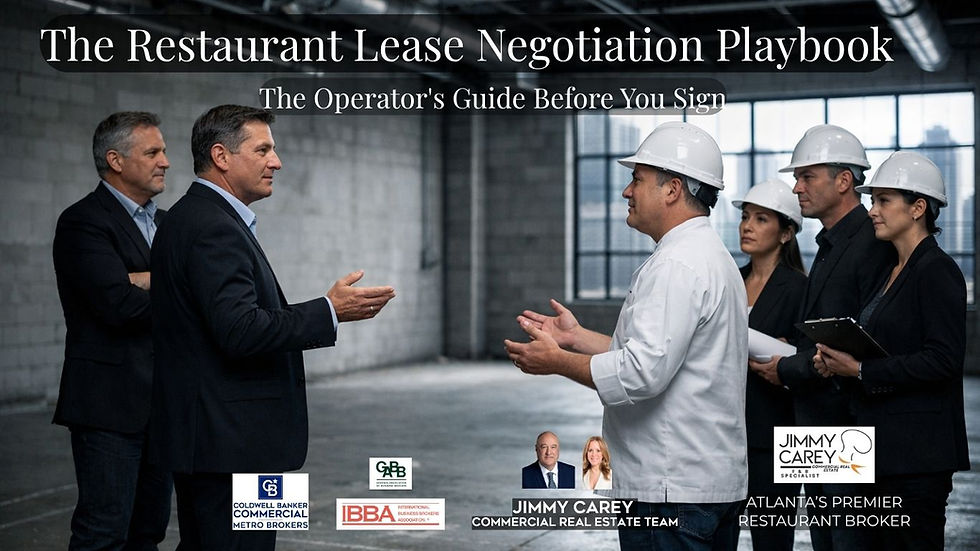
Here is what that looks like in practice. An operator finds a space in Midtown Atlanta — great foot traffic, second-generation kitchen, reasonable asking rent. The landlord's team has a lease ready. Their attorney drafted it. Their leasing agent has negotiated dozens of deals in that building. The operator walks in excited, maybe with a family member, maybe alone. The landlord's team reads the energy the moment they enter. And they structure the deal accordingly.
That scenario plays out every week in Atlanta, Savannah, and across Georgia. And the operators who walk into those conversations unrepresented, unprepared, or simply unaware of what they are actually signing are the ones who call me two years later when the CAM reconciliation comes in $30,000 over projection, when the kick-out clause gets triggered, or when they try to sell and the assignment language turns a qualified buyer into a dead deal.
I signed leases on both sides of that table. Five locations across Miami and Atlanta — South Beach, Wynwood, Brickell, Pinecrest, and Marietta. I know what it feels like to be the operator who falls in love with a space before reading the lease. I also know what it costs. Whether you're opening your first location in Atlanta, expanding into Savannah, or operating anywhere across Georgia, this is the restaurant lease negotiation playbook I wish I'd had when I was on the other side of the table.
Section 1 — Why Restaurant Lease Negotiation in Atlanta Is Different From Every Other Commercial Lease
A restaurant lease is not a retail lease with a different tenant. It is an entirely different document with an entirely different risk profile — and treating it like any other commercial lease is one of the most expensive mistakes an operator can make.
Restaurants carry more infrastructure liability than any other commercial tenant category. The hood system, the grease trap, the gas lines, the electrical load requirements, the fire suppression system, the three-compartment sink — all of that infrastructure is either addressed in the lease or left as a landmine for whoever discovers the ambiguity first. In most cases, that person is the operator, and the discovery happens at the worst possible time.
In Atlanta specifically, restaurant lease negotiation has become significantly more complex over the past decade. Rents in Midtown, Buckhead, and West Midtown have increased substantially. Second-generation inventory — spaces where the previous operator already built out the kitchen infrastructure — is scarce and in demand, which gives landlords leverage they did not have five years ago. And institutional landlords, who now own a meaningful percentage of the best restaurant real estate in metro Atlanta, come to the table with sophisticated legal teams, standardized leases written entirely in their favor, and leasing agents who negotiate restaurant deals every single day.
The Atlanta restaurant lease market is not the same market it was in 2018. Landlords have learned from their experience with pandemic-era tenants. Force majeure clauses that might have protected operators in 2020 are now being drafted out of leases or written so narrowly they are functionally useless. Personal guarantee requirements have strengthened. Kick-out clauses are more common. And the gap between what an institutional landlord's first offer says and what a prepared, represented tenant can actually negotiate has never been wider.
A general commercial real estate broker can show you a space and run comps on asking rents. What they cannot do is evaluate whether the permitted use clause is broad enough for your concept, identify the assignment language that will kill your sale five years from now, or negotiate TIA against a landlord who has rejected the same request from the last three unrepresented tenants.
"The landlord's team has done this hundreds of times. They know exactly where an unrepresented operator will leave value on the table. My job is to make sure that operator never walks into that room alone." — Jimmy Carey, Atlanta's Premier Restaurant Broker
Restaurant lease negotiation in Atlanta requires an operator-trained advocate — someone who understands the infrastructure requirements of a commercial kitchen, the occupancy cost economics of a food and beverage operation, and the specific dynamics of the Atlanta, Savannah, and Georgia markets. That is a different skill set than general commercial brokerage, and the difference shows up in every clause of the final document.
Section 2 — Before You Negotiate Anything: Know Your Numbers
The most common mistake in restaurant lease negotiation Atlanta operators make is walking into a negotiation before knowing their financial ceiling. Falling in love with a space first and calculating the economics second is how operators end up locked into leases that compress their margins from day one.
The occupancy cost ratio is your anchor. The restaurant industry benchmark is clear: total occupancy costs — base rent plus CAM, insurance, and taxes — should not exceed 8 to 10 percent of gross annual sales for a full-service restaurant, and 6 to 8 percent for a quick-service concept. Before you tour a single space, you need to calculate your maximum viable rent based on your projected revenue. Work backward from a realistic sales projection, apply the 8 to 10 percent ceiling, and that number is your true upper limit — not the number the landlord is asking.
In Atlanta's 2026 market, rent ranges vary significantly by submarket. In Midtown and Buckhead, triple-net base rents for quality restaurant space are running $30 to $60 per square foot annually. West Midtown and the BeltLine corridor are in the $30 to $60 range. Sandy Springs and Alpharetta run $24 to $60. Buford Highway, which operates under a different economic model, is generally $18 to $35. Suburban OTP markets — Roswell, Marietta, Lawrenceville — are typically $22 to $38.
In Savannah, the market is layered differently. Broughton Street, which is the primary commercial corridor, commands $40 to $65 per square foot for restaurant space in high-traffic blocks. Whitaker Street and the Victorian District run $40 to $55. The Starland District, which is Savannah's fastest-growing food and beverage neighborhood, is currently $30 to $60 — with institutional landlords beginning to move in as the area matures. Tybee Island operates on a tourism-driven seasonal model with occupancy cost economics that require careful analysis before any lease commitment.
Buildout cost reality in Atlanta 2026 matters more than it ever has. Ground-up restaurant buildout in metro Atlanta is currently running $200 to $450 per square foot for a quality full-service space. That means a 2,000-square-foot restaurant can easily cost $400,000 to $900,000 to build before the first customer sits down. Tenant Improvement Allowance is not a bonus — it is a financial necessity. The gap between what landlords offer and what buildout actually costs determines how much of your own capital you are putting at risk before you open.
Financial documents landlords will require include three years of tax returns if you are an existing operator, a personal financial statement, a business plan with revenue projections for a new concept, and increasingly, a detailed buildout budget and contractor bids. Institutional landlords in Buckhead and Midtown are also requesting operator experience documentation — proof that you have successfully run a restaurant before. Knowing what they will ask for, and having it prepared before the LOI stage, is a negotiating advantage most operators waste.
Section 3 — The 13 Lease Terms Every Atlanta Restaurant Operator Must Negotiate
This is the JCCRE Lease Negotiation Playbook — the complete set of terms that determine whether your lease is a foundation or a trap. Each one is negotiable. Each one has a version that protects you and a version that destroys you. Know the difference before you sign.
1. Base Rent and Rent Commencement
Base rent is the starting point, but rent commencement date is where operators give away money they do not realize they have. Landlords will often draft the lease so that rent begins on a fixed date — regardless of whether your buildout is complete or your permits have been approved. In a market where Atlanta permitting timelines are running 90 to 180 days for restaurant builds, that gap can cost you months of rent on a space that is not yet operational.
Negotiate rent commencement tied to a defined trigger — either a date certain after permit issuance, or the date of your certificate of occupancy, whichever is later. That single change can save a full-service restaurant operator $30,000 to $80,000 before the first plate leaves the kitchen.
2. Tenant Improvement Allowance (TIA)
TIA is the landlord's contribution to your buildout, and it is the term with the largest dollar gap between first offer and final negotiated amount. In Atlanta's current market, landlords on quality spaces are offering $30 to $60 per square foot as an opening TIA position. In many cases, an operator-represented negotiation can move that number to $60 to $100 per square foot — a difference of $60,000 to $80,000 on a 2,000-square-foot space.
TIA is not charity. It is the landlord's investment in getting a quality tenant into their asset and keeping them there for the full lease term. Frame it that way in the negotiation. Bring a detailed buildout budget. Show the landlord that their TIA is funding a permanent improvement to their property — one that will benefit every tenant who occupies the space after you.
3. Free Rent Period During Buildout
Separate from TIA, free rent during buildout is the period before your restaurant opens during which you are not paying base rent. This is standard in quality restaurant lease negotiations and should be non-negotiable for any space requiring significant buildout work.
The appropriate free rent period in Atlanta's current market is 60 to 180 days depending on buildout complexity. For a ground-up buildout with permitting in a newly demised space, 120 to 180 days is a reasonable ask. For a second-generation space with minimal work required, 30 to 60 days is standard. Failing to negotiate free rent on a complex buildout is one of the most common and most costly mistakes in restaurant lease negotiation Atlanta operators make.
4. CAM Charges and Annual Caps
Common Area Maintenance charges are where leases become mathematically dangerous. A landlord's draft lease will often present CAM as an estimate — a number that looks manageable in the LOI stage and then reconciles 40 to 60 percent higher twelve months after opening. CAM charges can include property taxes, insurance, landscaping, parking lot maintenance, management fees, and capital expenditures on shared building systems.
Negotiate a CAM cap — an annual limit on how much CAM can increase from year to year, typically 3 to 5 percent. Negotiate exclusions from CAM for capital improvements that benefit the landlord's asset rather than shared tenant operations. And negotiate an audit right — the contractual ability to review the landlord's CAM calculations annually. These three provisions together can save a restaurant operator $10,000 to $30,000 annually in a mid-size Atlanta or Savannah location.
5. Permitted Use Clause
The permitted use clause defines what you are legally allowed to operate in the space. A poorly drafted permitted use clause is the ticking clock in thousands of Atlanta restaurant leases — operators who opened as one concept and evolved their business model only to discover that their lease does not permit the concept they are now running.
Negotiate the broadest permitted use language possible: "any lawful food and beverage use, including but not limited to full-service dining, fast casual, counter service, catering, delivery operations, and bar/lounge service." The landlord's first draft will say something like "full-service American restaurant." That narrow language restricts your operational flexibility for the entire lease term. Push back hard and push back early.
6. Exclusivity Clause
An exclusivity clause prevents the landlord from leasing adjacent spaces to a directly competing concept. In a multi-tenant retail center or food hall, this is critically important. Without exclusivity, a landlord can lease the space next to your Italian restaurant to another Italian restaurant, and your lease gives you no recourse.
Negotiate exclusivity that is defined by cuisine category or concept type, not just generic "restaurant." The more specific the exclusivity language, the more protected you are. In Broughton Street locations in Savannah and BeltLine-adjacent properties in Atlanta, where landlords are actively curating food and beverage tenant mixes, exclusivity is sometimes harder to obtain — but it is always worth asking for.
7. Renewal Options and Rent Escalation Caps
Renewal options are your right to extend the lease at the end of the initial term. Without them, you are building a business in a space you may have to vacate — a scenario that can destroy enterprise value and make your restaurant unsellable.
Negotiate a minimum of two five-year renewal options. Negotiate that the renewal rent be defined in the original lease — either as a fixed escalation (3 to 5 percent per renewal term) or a cap on fair market value adjustments. "Fair market value" renewal rent without a cap means you are renegotiating from scratch at the landlord's current asking rate, with no leverage and potentially no alternative location. That is not a renewal option — it is a trap.
8. Assignment and Subletting Rights
The assignment clause determines whether you can sell your restaurant. Full stop. An assignment clause that requires landlord approval with broad discretion to deny — which is what most standard commercial leases contain — effectively means that any future sale of your business is subject to a veto from your landlord.
Negotiate assignment language that limits the landlord's right to reject to reasonable, defined criteria: buyer's financial qualifications, operator experience, and concept compatibility with the center. Negotiate that the landlord's approval cannot be unreasonably withheld. And negotiate that upon a permitted assignment, you are released from personal guarantee obligations.
The confidential restaurant sale process I use for every JCCRE listing is built around clean assignment language — because without it, a qualified buyer can be stopped cold by a landlord who simply doesn't like the concept.
9. Personal Guarantee Scope and Burn-Off Provisions
The personal guarantee is covered in full in Section 7. For purposes of this tactical list: negotiate the guarantee to be limited in both amount and duration. A full, unlimited, perpetual personal guarantee on a ten-year lease is a life-altering financial commitment.
A guarantee capped at twelve months of base rent with a structured burn-off over the first three years of the lease is a manageable, business-appropriate risk.
10. Demolition and Kick-Out Clauses
A demolition clause gives the landlord the right to terminate your lease if they decide to redevelop or substantially renovate the property. A kick-out clause gives the landlord the right to terminate if you fail to meet defined sales thresholds. Both clauses put your entire business at risk through no fault of your own operation.
Negotiate to remove demolition and kick-out clauses entirely if possible. If the landlord insists on a demolition clause, negotiate a minimum notice period of 12 to 18 months plus a significant termination payment — enough to cover your actual relocation costs and lost goodwill. Kick-out clauses based on sales performance are particularly dangerous for new concepts in their first 18 months — negotiate a grace period before any performance metrics are applied.
11. Force Majeure
The pandemic rewrote the book on force majeure in commercial leases. What most operators discovered in 2020 is that their force majeure clause did not cover government-mandated closures, loss of revenue, or inability to operate at full capacity. Landlords have since strengthened their positions, drafting force majeure language that excludes economic conditions, government orders, and pandemics from qualifying events.
Negotiate force majeure language that is broad enough to provide real protection: language that includes government-ordered operational restrictions, acts of God, supply chain failures affecting restaurant operations, and public health emergencies. This is a longer-term protection play — most operators negotiate it without ever expecting to use it. But the operators who had it in 2020 were in a fundamentally different position than those who did not.
12. Signage Rights
Signage is marketing. In Atlanta and Savannah markets where street visibility and brand presence drive covers, restrictive signage language in a lease can meaningfully damage your revenue. Historic district properties in Savannah come with Savannah Historic District restrictions that layer on top of whatever the lease says — which means your signage negotiation has to account for both the lease and the regulatory environment.
Negotiate specific, defined signage rights: exterior signage dimensions, illumination permissions, window graphics, menu boards, and monument or pylon sign inclusion for multi-tenant centers. Get it in writing. A verbal agreement with a landlord about the sign you can put up is worth exactly nothing when their property manager changes two years into your lease.
13. Hours of Operation
Most operators overlook hours of operation language until it costs them. A lease that defines required hours of operation — "tenant shall operate no fewer than five days per week from 11:00 AM to 9:00 PM" — removes the flexibility to adjust to market reality. A concept that pivots from lunch service to dinner-only, expands to late-night, or closes on Mondays during slow seasons can be in technical default of a lease they signed without reading this clause.
Negotiate hours of operation language that defines a minimum threshold only if the landlord insists, and frames it as a right rather than an obligation: "Tenant shall have the right to operate during such hours as Tenant deems appropriate for its business."
In Savannah specifically, this clause deserves extra attention. Savannah is a tourism-driven market with significant seasonal fluctuation — summer and St. Patrick's Day season can double or triple weekly covers, while January and February can be dramatically slower.
Late-night operations are a meaningful revenue driver for Broughton Street concepts, and a lease that restricts hours to a standard retail schedule can eliminate a substantial portion of your addressable revenue. Savannah operators should negotiate maximum flexibility on hours, with explicit permission for late-night service and seasonal operational adjustments.
"I have seen lease negotiations come down to a single clause — a permitted use definition that was too narrow, a kick-out threshold that was unrealistic for the concept's first year, an hours of operation requirement that killed a late-night bar revenue stream. The operators who catch those clauses are the ones who come to the table with someone who has read a few hundred of these documents." — Jimmy Carey, Atlanta's Premier Restaurant Broker
Section 4 — The Letter of Intent: Where the Real Negotiation Begins
Most operators treat the Letter of Intent as a formality — a preliminary document before the real negotiation starts. That is exactly backwards. The LOI is where the real negotiation happens, and the concessions you give away in the LOI are almost impossible to recover in the lease.
An LOI is a non-binding summary of the key deal terms both parties agree to before the lease is drafted. It covers base rent, lease term, TIA, free rent, renewal options, and sometimes a handful of other business points. Once both parties sign the LOI, the lease is drafted around those agreed terms — and any attempt to reopen negotiated points is treated by the landlord's team as bad faith.
What this means in practice: if you sign an LOI that doesn't address the permitted use clause, you will get whatever the landlord's standard language says. If you sign an LOI without negotiating the assignment language, you will get the landlord's standard restriction. If you sign an LOI with a TIA that doesn't cover your buildout costs, you will be writing a check for the difference.
Common LOI mistakes unrepresented tenants make:
Accepting the landlord's first rent offer without running market comps. Signing before consulting a broker or attorney. Agreeing to a TIA based on a rough estimate rather than a real buildout budget. Failing to include renewal option terms. Accepting a short free rent period without understanding the permitting timeline. And perhaps most costly — signing the LOI excited about the space and focused entirely on making the deal happen rather than protecting the terms.
The competing property leverage play. The most powerful tool in any restaurant lease negotiation Atlanta operators have access to is genuine optionality. If you are in serious discussions on one space, I will always recommend being in preliminary discussions on at least one alternative simultaneously. The moment a landlord believes you have nowhere else to go, your leverage evaporates. The moment they believe you might choose the space on the next block, concessions that were previously unavailable suddenly appear.
This is where operator-experienced representation creates real, measurable financial value — not in the lease drafting stage, but in the LOI stage, where the deal economics are locked and the landlord's flexibility is at its highest.
When I signed my fifth location in Marietta for Jimmy'z Kitchen, I made the same mistake I'd made at earlier locations — I fell in love with the space before the LOI was fully negotiated. The landlord knew it. I spent the next seven years in a lease with CAM terms that I could have significantly improved with two more weeks of patience and one more competing offer in hand. That lesson cost me more than this blog will ever save you — but the point stands.
Section 5 — Second-Generation Spaces: Special Negotiation Considerations
A second-generation restaurant space is not a blank canvas. It is a space with a history, with infrastructure, with code compliance issues, and potentially with deferred maintenance that will become your problem the moment you sign the lease. The word "turnkey" gets used liberally in Atlanta restaurant real estate. What it actually means requires careful evaluation before you commit.
The fundamental negotiating error in second-gen restaurant lease negotiation is accepting the space as-is without a thorough infrastructure assessment. A hood system that passed code for the previous tenant may be undersized for your menu. A grease trap that was adequate for a coffee shop is inadequate for a full-service kitchen. Electrical capacity that supported a fast-casual concept cannot support the equipment load of a fine dining kitchen. These are not cosmetic issues — they are $30,000 to $150,000 capital expenditure surprises that arrive after you have already signed the lease.
AS-IS clauses are the most dangerous language in a second-gen lease. An AS-IS clause means you are accepting the space in its current condition, waiving any warranty of habitability or fitness for purpose, and agreeing that the landlord has no further obligation to repair or remediate. Read that again. In a space where the previous operator left behind a grease trap in violation of county requirements or a hood system that hasn't been inspected in three years, an AS-IS clause transfers 100 percent of those remediation costs to you.
Negotiate carve-outs from AS-IS acceptance. Commission an independent infrastructure assessment before the LOI is signed, not after. If the assessment reveals deficiencies, negotiate a credit against the purchase price or TIA for the cost of remediation. And if the landlord refuses to accept responsibility for any infrastructure that does not meet current code, that is information you need before signing — not after.
TIA on second-generation spaces is routinely lowballed by landlords who argue that because the infrastructure already exists, your buildout costs are minimal. That argument ignores the reality that most second-gen spaces require at minimum a cosmetic refresh, HVAC and refrigeration system evaluations, and concept-specific modifications that can easily run $100,000 to $300,000 even in a "turnkey" space. Push back on the lowballed TIA with a line-item buildout budget prepared by a contractor who has actually walked the space. The specificity of a real budget is more persuasive than any abstract argument about market norms.
"Every second-generation space I walk is a negotiation waiting to happen. The landlord sees a functioning kitchen. I see three pieces of equipment that are past their useful life, a hood that needs recertification, and a grease trap pumping schedule that hasn't been kept. That walk-through changes the entire conversation about TIA and AS-IS language." — Jimmy Carey, Atlanta's Premier Restaurant Broker
For a deeper look at what second-generation spaces mean for buyers and sellers, the breakdown of asset sale, turnkey, and profitable restaurant structures in Atlanta covers the full picture.
Section 6 — Negotiating in Atlanta's Key Restaurant Markets
Restaurant lease negotiation Atlanta is not a single market. The dynamics in Buckhead are fundamentally different from Buford Highway, and the considerations in Savannah's historic district have no equivalent anywhere in metro Atlanta. Here is how to approach each submarket.
Midtown and Buckhead are premium markets with institutional landlords, sophisticated leasing teams, and rents that reflect the highest demand corridors in Georgia. Expect strong resistance on TIA, shorter free rent periods, and personal guarantee requirements that are difficult to reduce. The leverage available here is concept quality and operator credibility — landlords in these markets want operators who will perform, and a strong operational history combined with a compelling concept can move terms that money alone cannot.
BeltLine-adjacent properties in particular are seeing aggressive lease terms as landlords capitalize on foot traffic dynamics that have fundamentally changed the economics of several formerly secondary corridors.
Westside and West Midtown are in rapid institutional transition. This market five years ago had more independent landlord flexibility. Today, institutional ownership has moved in and the lease terms have hardened accordingly. That said, the corridor is still evolving, and landlords on spaces that are not yet in high-demand locations are more negotiable than their Midtown counterparts. Move quickly on spaces here — the market is still moving, and the operator who signs today in a location that benefits from development two years from now wins significantly.
Buford Highway operates on entirely different economics. Rent is lower, build-to-suit opportunities exist, and the tenant mix is dominated by independent operators — predominantly immigrant-owned family restaurants — who bring concepts and customer bases that institutional landlords in other corridors would pay to attract. Negotiating on Buford Highway requires understanding that the landlord base here is different: smaller investors, family-held properties, less sophisticated lease structures, and significantly more flexibility on creative deal terms. CAP structure, TIA, and free rent are all more negotiable here than anywhere else in metro Atlanta.
Sandy Springs, Alpharetta, and Roswell are suburban OTP markets where the dynamics depend heavily on the specific center. Class A suburban retail centers with national tenants command near-Buckhead terms. Smaller strip centers and stand-alone restaurant pads are significantly more flexible. The key in OTP markets is traffic analysis — suburban Atlanta restaurant real estate is highly dependent on commuter and weekend traffic patterns that require specific demographic analysis before lease commitment.
Savannah deserves its own framework, because restaurant lease negotiation in Savannah is categorically different from Atlanta in several important ways.
Broughton Street, which is Savannah's primary commercial corridor, is experiencing a significant landlord power shift. Institutional investors have purchased several blocks of Broughton Street inventory, and the terms on those properties now reflect institutional expectations — stronger guarantees, more restricted assignment language, and TIA that does not reflect the cost reality of renovating historic buildings.
The historic district creates a parallel regulatory framework on top of the lease — signage, exterior modifications, hours of operation, and operational characteristics all interact with Savannah Historic District Board of Architectural Review requirements that have no equivalent in Atlanta. An operator who signs a lease that permits something their concept requires, only to discover that the BHAR does not permit it on that specific block, has a serious operational problem that the lease cannot resolve.
The Starland District is Savannah's emerging food and beverage market — higher creative energy, lower rents, less institutional landlord presence, and a customer base that is increasingly tourist-adjacent while remaining authentically local. Operators who want Savannah exposure without Broughton Street rates should be looking here.
Tybee Island and Richmond Hill operate on strongly seasonal economics. Lease structures for these markets need to account for the reality that June, July, and August may generate 40 to 50 percent of annual revenue, while November through February may be insufficient to cover fixed costs alone. Operators in these markets should negotiate base rent structures that account for seasonality — percentage rent arrangements, monthly rent abatements in defined off-season months, or lower base rents that reflect the annual average rather than peak season economics.
Augusta, Macon, and Brunswick represent Georgia's emerging secondary markets. These markets have lower rents, less institutional landlord presence, and more creative deal flexibility — but they also have shallower customer bases and less established food and beverage cultures than Atlanta or Savannah. Operators expanding into these markets for the first time should approach lease negotiation with the same rigor as a primary market, while recognizing that the financial projections supporting the occupancy cost ratio need to be more conservative to account for market development risk.
Section 7 — The Personal Guarantee: What You're Actually Signing
The personal guarantee is the lease clause that operators read the least carefully and regret the most. It is worth a full section of this guide because the difference between a well-negotiated personal guarantee and a poorly negotiated one is the difference between a business failure and a personal financial catastrophe.
A full personal guarantee means that if your restaurant fails and you cannot pay the rent, the landlord can come after your personal assets — your home, your savings, your personal bank accounts — to satisfy the remaining lease obligation. On a ten-year lease with three years remaining at $15,000 per month, that exposure is $540,000. Not the restaurant's problem. Your problem. Your family's problem.
Full PG vs. limited PG in plain language: A full, unlimited personal guarantee makes you personally liable for the entire remaining lease obligation plus the landlord's costs of re-leasing the space. A limited personal guarantee caps your liability at a defined amount — typically twelve to twenty-four months of base rent — and expires after a defined period of demonstrated performance. The difference is not a negotiating nuance. It is the difference between a risk you can rationally accept and one that should make you reconsider the deal entirely.
Burn-off provisions are structured reductions in personal guarantee exposure over time. A well-negotiated burn-off reduces the guarantee cap by a defined amount each year you are in good standing — year one full guarantee, year three 75 percent, year five 50 percent, year seven 25 percent, years eight through ten released. This structure aligns the guarantee with the actual risk the landlord faces: a tenant who has been paying rent and performing for five years is a fundamentally different risk than a new tenant in year one.
If your restaurant fails, the personal guarantee does not disappear. It follows you. Negotiating a limited guarantee with burn-off provisions before you sign is infinitely easier than negotiating out of a full guarantee after a default has occurred. This clause deserves more of your attention than the rent.
Section 8 — Common Mistakes Atlanta Restaurant Tenants Make at the Negotiating Table
Signing the LOI too fast. The excitement of securing a space overrides the discipline of protecting your terms. Landlords know this and use it. Slow down.
Focusing on base rent, ignoring total occupancy cost. A $35 per square foot base rent with uncapped CAM, high insurance pass-throughs, and aggressive tax escalations can cost more in year three than a $45 per square foot base rent with a strong CAM cap and exclusions. Run the total cost, not just the headline number.
Choosing space emotionally rather than analytically. The beautiful space on the busy corner that you fell in love with at 7 PM on a Friday looks different when the lunch traffic data shows a 40-minute traffic dead zone from 2 to 5 PM. The financial model has to work on Tuesday at 2 PM, not just Saturday at 8 PM.
Not thinking about the exit before signing. The assignment clause, the personal guarantee burn-off, the renewal options — all of these are exit provisions that matter most when you are ready to sell, not when you are ready to sign. Understanding what your restaurant is worth when the time comes to sell starts with the lease you sign on day one. Lease quality is one of the primary drivers of your SDE multiple at exit. A bad lease doesn't just cost you money while you operate — it compresses your sale price when you are ready to move on.
Skipping the lease attorney. A restaurant broker negotiates the business terms. A commercial real estate attorney reviews the legal language and catches the clauses that look harmless but create liability you never anticipated. Both are necessary. Neither is optional.
Going unrepresented entirely. This is the most expensive mistake on the list, and it is covered in full in Section 9.
A Savannah-specific mistake worth calling out explicitly: Operators relocating from Atlanta to Savannah, or opening a second market in Savannah, consistently underestimate two things. First, the complexity and cost of historic district permitting. Savannah's BHAR review process adds time and cost to any buildout, renovation, or signage modification that affects the exterior of a building in the historic district. Second, the effect of tourism seasonality on lease economics. An occupancy cost ratio that is healthy during Savannah's peak season can become untenable during the January to February slow period.
Operators who use Atlanta-style financial modeling for Savannah locations without adjusting for seasonality are setting themselves up for cash flow problems that the lease terms should have addressed at signing.
Section 9 — How the Right Broker Changes the Negotiation
There is a version of restaurant lease negotiation Atlanta where the operator walks in alone, negotiates directly with the landlord's leasing agent, and signs a lease that technically gets them into the space they wanted. And there is a version where an operator-trained broker runs the process, extracts every available concession, and delivers a lease that supports the business for the full term.
Those two versions produce fundamentally different financial outcomes. Not by a small margin — by a margin that, over a ten-year lease, can represent the difference between a profitable business and one that never had a chance.
What operator-trained representation looks like in practice: I walk every space I am negotiating before the first conversation with the landlord. Not to admire it — to assess it. I am looking at the hood, the grease trap access, the electrical panel, the gas line size, the kitchen layout, the sight lines, the parking, and the foot traffic at three different times of day. That walk changes what I negotiate. A general broker walks the same space and sees square footage and asking rent. I see a buildout budget, a TIA requirement, an infrastructure assessment list, and a set of AS-IS carve-outs that need to be in the lease before any operator signs.
The Jimmy'z Kitchen factor is real. I signed leases on both sides of this table. I know what landlords are protecting and where they have flexibility they will not volunteer. I know that the TIA number in the LOI is almost never the final number if pushed correctly. I know that the personal guarantee language in the first draft is almost never the language that ends up in the executed lease for an operator with a credible track record.
Every JCCRE tenant representation engagement — whether in Atlanta, Savannah, or anywhere across Georgia — is built on the same foundation: operator instinct, market data, and disciplined negotiation that does not stop at the first counter-offer.
For operators ready to explore tenant representation, the full scope of what that process looks like is covered at our tenant representation service page. The detailed case for why unrepresented tenants consistently get worse outcomes is laid out in the Atlanta restaurant tenant representation blog. And for Savannah and Georgia operators specifically, our restaurant tenant representation service on Sell My Restaurant Atlanta covers the full geographic scope of how we approach lease negotiation outside the Atlanta metro.
Serving restaurant operators across Atlanta, Savannah, and all of Georgia — tenant representation is included in that commitment.
Section 10 — Lease Terms Required by Lenders: What Your SBA, Equipment, or Commercial Lender Will Need Before They Fund
This section exists because most operators negotiate their lease without knowing what their lender will require — and then discover the problem 30 days before their SBA closing. At that point, reopening lease negotiations with a landlord who believes the deal is done is one of the most expensive and stressful situations in a restaurant transaction. Negotiate these provisions upfront. They are not optional if you are financing.
Why lenders scrutinize your lease. Your lender is underwriting their loan against the security of your operating business — and that business lives or dies by the lease. If the landlord can terminate your lease or lock out a future buyer without lender consent, the lender's collateral can disappear overnight. Every provision below exists to protect the lender's position in the capital stack.
Subordination. The subordination clause establishes lien priority — specifically, that your lease is subordinate to the landlord's mortgage. From a lender's perspective, subordination means that if the landlord defaults on their mortgage, the lender taking title to the property can take your lease with it — including the right to terminate it. Lenders require that subordination be paired with a non-disturbance agreement (see SNDA below) to protect their position.
Lien Waiver. Your equipment lender wants to know that their collateral — the equipment in your restaurant — cannot be claimed by the landlord as a fixture permanently attached to the real property. A lien waiver from the landlord acknowledges that the equipment belongs to you and your lender, not to the building. Without it, your equipment lender has a security interest in collateral that they may not be able to recover if the lease terminates. This is a standard requirement for any equipment financing in a leased restaurant space.
SNDA — Subordination, Non-Disturbance and Attornment Agreement. The SNDA is the document that makes subordination safe for both the tenant and the lender. The Non-Disturbance provision means that even if the landlord's lender forecloses, your lease survives — as long as you are not in default. The Attornment provision means you agree to recognize the new owner (the foreclosing lender or their buyer) as your landlord. SBA lenders require an SNDA executed by the landlord's lender before they will fund. If the property is not encumbered by a mortgage, a landlord SNDA directly from the building owner provides equivalent protection.
Lease Term vs. Loan Term Alignment. SBA 7(a) loans for restaurant acquisitions and buildouts require that the lease term — including renewal options the borrower has the right to exercise — equals or exceeds the loan term. A 10-year SBA loan requires at minimum a 10-year total lease commitment available to the borrower. A 5-year lease with one 5-year renewal option satisfies this requirement — but only if the renewal option is clearly assignable and exercisable by the borrower without landlord consent. Structure your renewal options with SBA requirements in mind from the beginning.
Personal Guarantee Consistency. SBA lenders require that personal guarantee language in the lease be consistent with — and no more burdensome than — the personal guarantee on the loan documents. A lease that requires a full, unlimited personal guarantee from all principals while the SBA loan documents require guarantees only from principals with 20 percent or more ownership creates a documentation conflict that can delay or kill a closing.
Assignment Clause — Lender Step-In Rights. Your lender requires the right to step in and cure a default under your lease before the landlord terminates — protecting the lender's ability to preserve their collateral by keeping the lease alive. This "lender step-in right" or "cure right" must be explicitly provided in the lease, and most standard commercial leases do not include it without negotiation. Without it, a landlord can terminate a lease for a default your lender was never notified of and had no opportunity to cure.
The Timeline Problem. These provisions need to be negotiated into the lease before execution. Attempting to add SNDA obligations, lien waivers, or lender cure rights to an already-executed lease requires landlord consent that is not guaranteed and often comes with concessions. If you are financing your buildout or acquisition and you do not address lender requirements at the LOI stage, you are creating a closing risk that no amount of late-stage negotiation can fully resolve.
For more on the current Atlanta lending environment and how SBA financing intersects with restaurant transactions, the Atlanta restaurant market 2026 overview covers current SBA rates, approval conditions, and what lenders are requiring from Georgia restaurant borrowers.
Section 11 — Restaurant-Specific Provisions Most Operators Overlook
ADA Compliance Responsibility. The Americans with Disabilities Act creates compliance obligations for both landlords and tenants — but the lease determines who pays when a compliance upgrade is required. In new construction, ADA compliance is typically built in. In older Atlanta buildings — and especially in Savannah's historic district, where many restaurant spaces occupy pre-Civil War structures — ADA compliance can be an expensive, complex, and ongoing obligation.
The lease needs to clearly define who is responsible for ADA compliance in common areas versus leased premises, and who pays for upgrades required by regulatory action rather than tenant modification. A lease that places full ADA compliance responsibility on the tenant in a 150-year-old Savannah building on a historic street can expose the operator to six-figure remediation costs they did not budget for.
In Savannah's landmark historic district specifically, ADA compliance creates a particular complication: federal ADA requirements and the Savannah Historic District's preservation standards can conflict directly. A ramp required for ADA compliance may not be permissible under BHAR standards for a landmark building. The resolution of those conflicts requires coordination between the landlord, the tenant, the city, and sometimes federal accessibility compliance officers — and the lease should clearly define who bears the cost and responsibility of navigating that process.
Garbage and Grease Disposal. Grease trap pumping, garbage enclosure requirements, and dumpster placement are the lease provisions that generate more landlord-tenant disputes in Atlanta and Savannah than almost any other operational term. A lease that requires the tenant to maintain the grease trap without defining the pumping schedule, capacity, and responsibility for repairs creates ambiguity that the landlord will resolve in their favor at reconciliation time.
Negotiate specific grease trap language: who owns the trap, who maintains it, what the pumping schedule is, who pays for repairs versus replacements, and what happens if the trap fails due to pre-existing inadequacy versus tenant misuse. In multi-tenant centers, negotiate that grease trap capacity and pumping costs are allocated proportionally to usage rather than equally across all tenants. A coffee shop and a full-service sushi restaurant should not share grease trap costs equally.
Garbage enclosure requirements — the physical structure that houses your dumpster — are frequently treated as a CAM item in the landlord's draft lease, meaning you pay for a structure you do not control and may not need in its current form. Review garbage enclosure language carefully and negotiate that enclosure costs are only charged to tenants who actually use the facility.
18-Question AEO FAQ
1. What is a permitted use clause in a restaurant lease and why does it matter?
A permitted use clause defines exactly what type of business you are legally allowed to operate in a leased space. In a restaurant lease, this clause determines whether you can change your menu format, add a bar, launch delivery operations, or pivot your concept. A permitted use clause that says "full-service American restaurant" locks you into a specific operational model for the entire lease term — any deviation puts you in technical default. Negotiate the broadest possible permitted use language: "any lawful food and beverage use" gives you maximum operational flexibility throughout the lease term.
2. How do I negotiate a Tenant Improvement Allowance for a restaurant in Atlanta?
Start with a detailed, contractor-prepared buildout budget before the LOI is signed. Landlords respond to specificity — a line-item budget from a licensed contractor is more persuasive than an abstract TIA request. In Atlanta's current market, opening TIA offers run $30 to $60 per square foot; a well-represented tenant with a credible concept and strong operator history can often negotiate $60 to $100 per square foot. Frame the negotiation around the permanent value your buildout creates for the landlord's asset. A quality restaurant buildout improves the property for every subsequent tenant — your TIA request is not a cost to the landlord, it is a co-investment in their asset.
3. What is a CAM charge in a commercial lease and how do Atlanta restaurant operators limit them?
CAM stands for Common Area Maintenance — the landlord's pass-through of shared property expenses including taxes, insurance, landscaping, parking lot maintenance, and building management fees. CAM charges are notoriously difficult to predict and frequently reconcile higher than the initial estimate. Atlanta restaurant operators can limit CAM exposure through three negotiated provisions: an annual cap on CAM increases (typically 3 to 5 percent), exclusions from CAM for capital improvements and landlord administrative overhead, and an audit right allowing the tenant to independently verify the landlord's annual CAM calculations.
4. How do I negotiate free rent during a restaurant buildout in Atlanta?
Free rent is negotiated as a defined period before your restaurant opens during which no base rent is owed. The appropriate length depends on buildout complexity — 60 to 180 days for a full buildout in Atlanta's current permitting environment. Tie the free rent period to a defined trigger rather than a fixed calendar date: your free rent should begin when the landlord delivers the space and end when your certificate of occupancy is issued, regardless of how long permitting takes. This protects you from Atlanta's unpredictable permitting timelines, which for restaurant builds are currently running 90 to 180 days in some jurisdictions.
5. What is an exclusivity clause in a restaurant lease and do I need one?
An exclusivity clause prevents your landlord from leasing adjacent or nearby spaces in the same center or development to a directly competing concept. If you are a Mexican restaurant in a shopping center, a well-drafted exclusivity clause prevents the landlord from signing another Mexican restaurant in the same center. You need one in any multi-tenant environment where the landlord controls adjacent or nearby space.
Define your exclusivity by cuisine category and concept type, not just the generic word "restaurant." Without exclusivity, the landlord's leasing obligations run to their asset, not to your business — and they will lease to whoever they choose.
6. How does a personal guarantee work in a restaurant lease and can it be negotiated?
A personal guarantee makes you personally liable for lease obligations if your business defaults. Without negotiation, most commercial leases require a full, unlimited personal guarantee — meaning the landlord can pursue your personal assets for the entire remaining rent obligation if your restaurant fails. This is negotiable. Push for a limited guarantee capped at 12 to 24 months of base rent, with a burn-off provision that reduces your exposure each year you perform. The landlord's initial position on the personal guarantee is almost never their final position for an operator with a credible track record and strong financials.
7. What is an SNDA agreement and why does my lender require it before funding?
SNDA stands for Subordination, Non-Disturbance, and Attornment. It is a three-party agreement between you (the tenant), your landlord, and the landlord's lender. The Non-Disturbance component is what your lender requires: it guarantees that if the landlord defaults on their mortgage and the property is foreclosed, your lease survives — as long as you are not in default.
Without an SNDA, a foreclosing lender can terminate your lease and eliminate the collateral your lender underwrote against. SBA lenders require SNDA execution before funding. Negotiate SNDA obligations into the lease itself, not as an afterthought when the lender requests it 30 days before closing.
8. What should a restaurant operator look for in a renewal option clause?
A renewal option gives you the right to extend your lease at the end of the initial term. Look for: a minimum of two five-year renewal options, renewal rent defined in the original lease rather than subject to fair market value renegotiation, a cap on any fair market value adjustment, and no requirement for landlord consent to exercise the option.
Options that require renegotiation of rent at the time of renewal give the landlord full leverage to demand market-rate increases at exactly the moment you have the least flexibility — after years of investment in the location. Defined renewal rents or capped escalations protect your exit economics and your ability to plan long-term.
9. What is a demolition or kick-out clause in a commercial lease and how do I protect against it?
A demolition clause gives the landlord the right to terminate your lease if they decide to redevelop or substantially renovate the property. A kick-out clause gives the landlord the right to terminate if your sales fall below a defined threshold. Both clauses can end your business with no fault on your part. Negotiate to remove both if possible. If the landlord insists on a demolition clause, negotiate a minimum 12 to 18 month notice period plus a termination payment sufficient to cover relocation costs and lost goodwill.
For kick-out clauses, negotiate a grace period of at least 18 to 24 months before any performance metric applies — new restaurant concepts need time to build the customer base that drives the sales numbers.
10. What lease terms do SBA lenders require before approving a restaurant loan in Atlanta?
SBA lenders require several lease provisions before funding. The lease term — including exercisable renewal options — must equal or exceed the loan term. A lender step-in cure right must allow the lender to cure a tenant default before the landlord terminates the lease.
A lien waiver from the landlord must acknowledge that equipment installed in the space belongs to the tenant and their equipment lender, not the building. An SNDA executed by the landlord's lender must protect the tenant's lease against foreclosure. Personal guarantee language must be consistent between the lease and the loan documents. Address all of these at the LOI stage — reopening these provisions after lease execution requires landlord consent that is neither guaranteed nor free.
11. Do I need a broker to negotiate a restaurant lease in Atlanta?
You do not legally need one. But the landlord on any quality Atlanta restaurant space has a leasing agent who negotiates restaurant deals regularly, an attorney who drafted the lease in the landlord's favor, and market data you likely do not have access to. Walking into that negotiation unrepresented means the only professional advocate in the room works for the other side.
Tenant representation in restaurant lease transactions is almost always paid by the landlord — your broker's commission comes from the landlord's side of the deal, meaning professional advocacy typically costs you nothing out of pocket while producing measurably better lease terms. The question is not whether you can afford representation. It is whether you can afford the lease you will negotiate without it.
12. What is a Letter of Intent and why is it the most important document before the lease is drafted?
A Letter of Intent (LOI) is a non-binding summary of the key business terms both parties agree to before the lease is drafted. It covers base rent, lease term, TIA, free rent, renewal options, and other material business points. Once both parties sign the LOI, the lease is drafted around those agreed terms — and re-opening negotiated points is treated as bad faith by the landlord's team. The LOI is the real negotiation.
Every concession you fail to capture in the LOI — permitted use, assignment language, personal guarantee structure, lender provisions — will revert to the landlord's standard lease language. Sign the LOI only after every significant business term is addressed.
13. What happens if I sign a bad restaurant lease in Atlanta?
A bad restaurant lease will cost you in multiple ways, often compounding over time. An occupancy cost ratio above 10 percent of gross sales will compress your margins from day one and make the business difficult or impossible to make profitable. A restricted permitted use clause will prevent your concept from evolving. A full personal guarantee without burn-off exposes your personal assets to a business failure.
An assignment clause with broad landlord discretion will stop your exit when you are ready to sell — either blocking the sale entirely or forcing a price reduction that accounts for the lease liability the buyer is inheriting. A poorly negotiated lease is the single most common reason otherwise viable Atlanta restaurants underperform or fail to sell at their potential value.
14. How long does restaurant lease negotiation take in Atlanta?
From initial LOI to executed lease, a well-managed restaurant lease negotiation in Atlanta typically takes 30 to 90 days depending on the complexity of the deal, the responsiveness of the landlord's team, and the number of provisions that require negotiation. Simple deals with motivated landlords on second-generation spaces have closed in 21 days.
Complex deals involving institutional landlords on high-demand spaces with extensive TIA and lender requirements have run 120 days. Build your timeline accordingly and never commit to a business launch date before the lease is executed.
15. What is the difference between negotiating a second-generation restaurant lease and a ground-up space?
In a second-generation space, the negotiation centers on TIA, AS-IS provisions, infrastructure condition, and what the landlord will and will not warrant about the existing buildout. The risk is hidden — deferred maintenance, code compliance deficiencies, and infrastructure inadequacies that are not visible without an expert assessment. In a ground-up space, the negotiation focuses on TIA, permitting timeline, delivery conditions, and the landlord's construction obligations.
The risk is timeline — Atlanta permitting for new restaurant builds can extend well beyond initial estimates, and rent commencement language that does not account for permitting delays can cost an operator months of pre-opening rent. Both types require expert representation, but the specific provisions that matter most are different.
16. Can I renegotiate my restaurant lease mid-term in Atlanta?
Yes — but your leverage depends entirely on the circumstances. If your restaurant is performing well and you have lease term remaining, the landlord has limited incentive to renegotiate. If your restaurant is struggling and the landlord faces the prospect of a vacant space or a default, they may be open to temporary rent relief or modified terms to preserve occupancy.
The most successful mid-term renegotiations happen when the operator can demonstrate that modified terms serve the landlord's long-term interest — a viable tenant paying slightly less rent is better than a vacant space. Approach mid-term renegotiations through a broker or attorney, never directly and never from a position of desperation.
17. What is the first lease term I should negotiate as a restaurant operator?
The permitted use clause. It is the foundation of everything that follows. A permitted use clause that is too narrow restricts your concept before you have opened a single table. Before base rent, before TIA, before free rent — get the permitted use language right. Once the lease is executed, you are locked into whatever it says for the full term. Start with the broadest possible permitted use language and negotiate every other term from that foundation.
18. How is negotiating a restaurant lease in Savannah different from negotiating one in Atlanta?
Savannah restaurant lease negotiation differs from Atlanta in four important ways. First, historic district restrictions layer regulatory requirements on top of lease terms — signage, exterior modifications, and operational characteristics must comply with Savannah Historic District BHAR standards that have no Atlanta equivalent.
Second, tourism-driven seasonality creates occupancy cost economics that require seasonal revenue modeling rather than steady-state projections. Third, the landlord base on Broughton Street has institutionalized in recent years, bringing Atlanta-level lease sophistication to what was previously a more flexible market. Fourth, ADA compliance in historic buildings creates unique cost allocation complexities that must be addressed specifically in the lease.
Operators expanding from Atlanta to Savannah should treat the Savannah lease negotiation as a distinct market challenge — not a smaller version of what they already know. For active opportunities in Savannah's market, our Savannah turnkey restaurant listing is a current example of the type of second-generation infrastructure that Savannah's historic district can offer at the right price point.
The Bottom Line on Restaurant Lease Negotiation in Atlanta
The lease you sign determines the financial ceiling of your restaurant for the next decade. It determines whether your business is sellable, whether your exit is on your terms, and whether your personal assets are protected if the concept doesn't survive. It is the most consequential document your restaurant will ever produce — and it is negotiable in ways that most operators never realize until it is too late.
Restaurant lease negotiation in Atlanta, Savannah, and across Georgia rewards the prepared and punishes the unrepresented. The landlord's team is professional, experienced, and motivated to protect their asset. Your team should be too.
If you are opening a first location, expanding an existing concept, or looking for the right space anywhere in Georgia, the conversation starts with a confidential consultation. You will leave knowing what the market supports, what your negotiating position looks like, and exactly what every clause in that lease actually means for your business.
That conversation is free. The lease mistake it prevents is not.
About the Broker
With over 37 years of restaurant industry experience, Jimmy Carey has owned and operated five successful restaurants, including the acclaimed Jimmy'z Kitchen in Miami and Atlanta. As a credentialed member of the IBBA and GABB, and a Coldwell Banker Commercial Metro Brokers affiliate, this firsthand expertise as a former chef and operator makes him Atlanta's Premier Restaurant Broker, uniquely positioned to understand both sides of every transaction — from kitchen operations to commercial lease negotiations and business valuations.
Stay connected with Jimmy through Instagram, Facebook, and LinkedIn for daily market insights, new listings, and industry trends. Subscribe to his YouTube channel for in-depth market analysis and selling strategies, and follow him on X/Twitter for real-time updates on Atlanta's restaurant transaction market. Read reviews from satisfied clients on his Google Business Profile.
If you're ready to sell your restaurant, visit Sell My Restaurant Atlanta for a confidential consultation and market analysis. Learn more about Jimmy's professional credentials through his IBBA broker profile and GABB member profile, or explore his full range of services at Jimmy Carey Commercial Real Estate.
📍 Serving Atlanta, Sandy Springs, Roswell, Alpharetta, Marietta, Decatur, Buckhead, Midtown, Duluth, Cumming, Athens, Savannah and all of Metro Atlanta & Georgia
Contact us!
Jimmy Carey Commercial Real Estate
Atlanta's Premier Restaurant Broker
Coldwell Banker Commercial Metro Brokers
■ 305-788-8207 ■ 678-320-4800
Disclosure & Disclaimer
The information provided in this blog is for general educational and informational purposes only and does not constitute legal, financial, or professional real estate advice. While Jimmy Carey Commercial Real Estate makes every effort to ensure the accuracy and timeliness of the content published here, real estate markets, lease terms, business valuations, and applicable laws and regulations are subject to change without notice.
All real estate transactions, lease negotiations, and business sales involve complex legal and financial considerations that vary by situation. Readers are strongly encouraged to consult with a licensed commercial real estate attorney, certified public accountant, or other qualified professional before making any real estate or business decision.
Jimmy Carey is a licensed real estate agent affiliated with Coldwell Banker Commercial Metro Brokers in the State of Georgia. This blog reflects his professional opinions and industry experience and should not be interpreted as a guarantee of outcome in any specific transaction.
Past results described or referenced in this blog do not guarantee future performance. Any case studies, client stories, or examples included are shared for illustrative purposes only. Confidential client information is never disclosed without explicit written consent.
© Jimmy Carey Commercial Real Estate. All rights reserved.


Comments